


Water butts are an excellent way of saving rainwater but they can get smelly. If heavy rain is forecast it is a good idea to take the opportunity to empty your butt out and give it a thorough clean. For continued sweet water Harrod Horticultural sell bags of EM Ceramic chips (£13.95) which will keep water fresh for 10 years. Each bag will treat 250 litres of water.
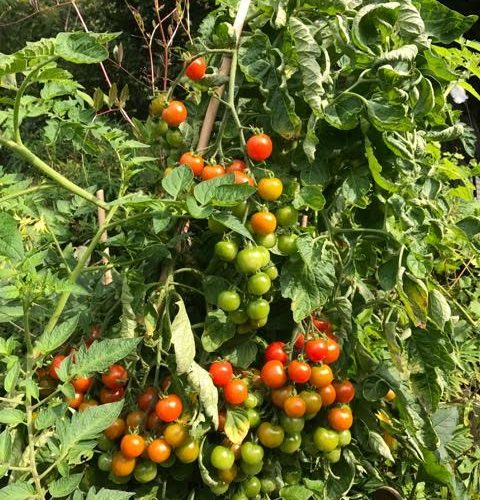
Two days of proper rain may have blighted the Bank Holiday, but the garden loves it. A friend rang me up this morning and said “ I swear I can see the plants growing!” That certainly seems to be the case in the greenhouse – suddenly the tomatoes are romping up their supports and I can see the first flower trusses forming. The four grow bags I can fit into the border of my 6×4 greenhouse allow me to grow 12 plants. Last year, despite the poor weather, we were picking tomatoes for months. I’m experimenting with something new this year – spiral plant supports – £14.95 for 3 from Unwins. My usual method is to support the plants by winding them round string that is fastened to an overhead wire. The re-useable spiral plant supports, also known as Veggie Cages, have been used in America for a while and have just found there way over here. Apparently they are brilliant at supporting and containing the tomatoes. I will report the results.
The hungry gap is behind us and we are starting to eat regularly from the garden and the allotment. We’ve enjoyed our first broad beans, have regular pickings of asparagus off the allotment, daily pickings of cut-and-come-again lettuce and for the past week, there have been sufficient strawberries for a generous helping on the morning muesli. And all the fresh herbs really give everything such a lift – I don’t know whether the past winter’s weather is the reason, but the mint is super size.
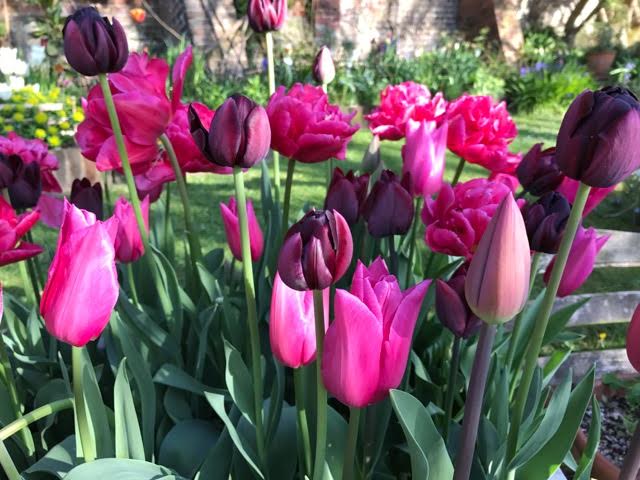
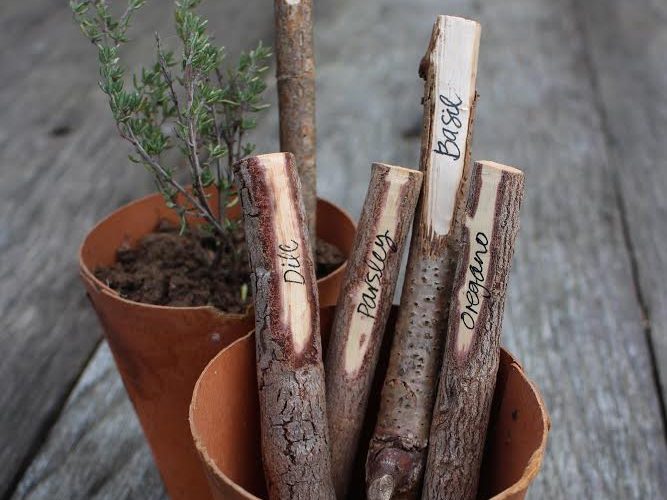
Over the weekend I emptied the tulips out of their pots in the courtyard and replaced them with a mixture of herbs, French beans and dahlias. It is a real suntrap at this time of year and there is nothing our cat loves better than sunbathing on a newly planted pot – especially once it has been topped with Strulch (my favoured mulch - its brilliant). So, to protect the plants, I have created hazel-twig cages – attractive cat deterrents that also act as plant supports!
Sown in the greenhouse: Zinnias and Morning Glories in peat-free coir pellets. Both their seedlings will sulk in the cold and hate root disturbance, so it is a good idea to delay sowing until now or even later for good results. In a couple of weeks they can be planted out into the garden.
Sown in the coldframe: Carrots –the cold frame isn’t much used during the summer months so I’ve sown carrot seed and covered the frame with Enviromesh. This will keep the pesky root fly at bay. With our deep sandy soil we should be able to grow brilliant carrots, but we’ve yet to succeed here, or on the allotment. Fingers crossed.
Sown outside: Spinach - in partial shade in an old galvanised water tank next to the greenhouse. Spinach tends to run to seed if growing in full sun during the summer and raising it up should keep it free of slugs and snails.
On the allotment: A mixture of squash plants
So, the Chelsea Flower Show is over half way through and I’ve had time to digest what I saw when I visited the show on Monday. It’s definitely not been a vintage year.
By the time the recession hit last autumn, most of the Chelsea gardens were well underway offsite, plants were growing and materials ordered. Some of the designers pulled out due to lack of sponsorship and among those that remained there was evidence of slashed budgets.
I suspect that next year will be much more interesting, as everyone adjusts to the new economic conditions. This year’s gardens weren’t designed with recession in mind – next year’s will be. I’m hoping that this will mean a lot of creative use of materials rather than the indulgence of well-nigh unlimited budgets.
So, despite my reservations, what caught my eye? Plants that appeared in several gardens included the lovely big seed heads of Angelica, lots of aquilegias and rich blue iris sibirica. Despite the best efforts of the designers to keep their choices secret, it does seem that certain plants pop up everywhere.
It was the small gardens where there was most inspiration – the ideas that anyone can take home and use. Each year I take photos of details that appeal to me – it might be a plant combination (although you need to bear in mind that not everything you see planted together will flower simultaneously in your own garden), a bit of hard landscaping or a plant support. Over the years I have used lots of these ideas in my own garden. I expect that the Hampton Court Show in July will provide similar inspiration.
Photo by Michelle Garrett
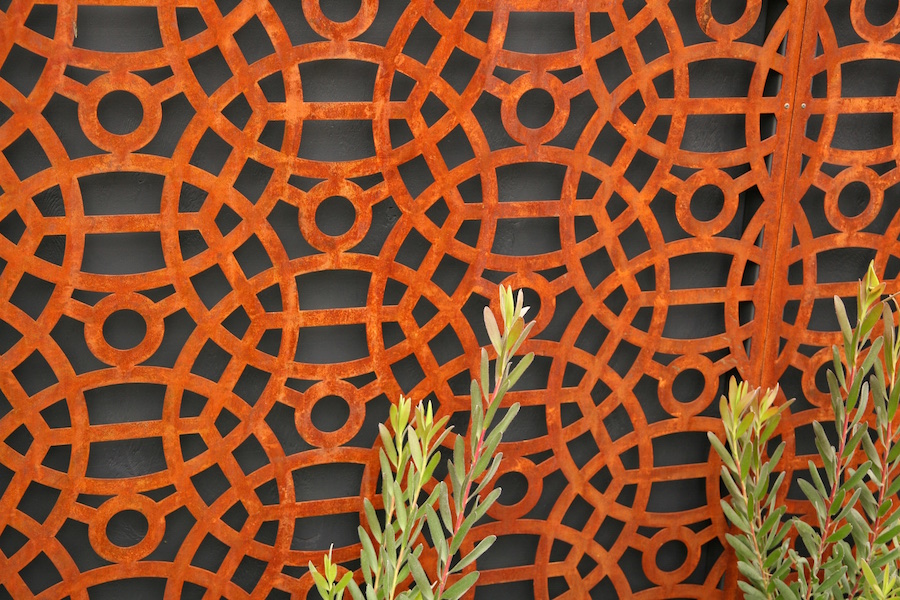
The gardens that really appeal to me are the ones that confound my prejudices, that make me reconsider a particular material or planting style. The Fenchurch Garden designed by Paul Hensey certainly made me look at concrete in an entirely new way. The curvaceous pillars intersected by wall planting (another popular theme) were so tactile that I longed to run my hands over them. I also loved the way that the planting ran up the wall from the herbaceous beds. Lots of inspiration there for a small walled garden.
I thought the log wall in the 1984 garden designed by Chris Gutteridge, Antony Cox and Jon Owens would be an inexpensive way to make a blank wall look interesting, while also providing habitats for insects and nesting places for birds.
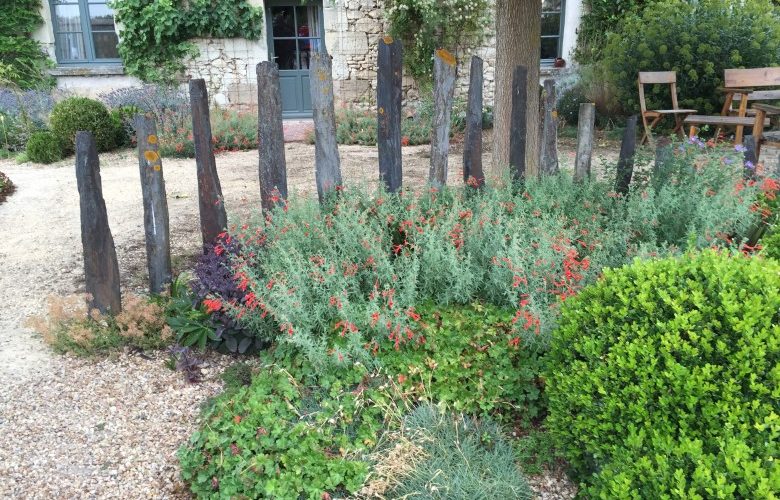
One of the problems in a small garden is to find a nice place to sit without sacrificing planting areas. Designers Angus Thompson and Jane Brockbank resolved this problem in the Nature Ascending garden by laying the deck around a tree. So often the ground beneath a tree is poor and plants are difficult to establish, so this seems a really good solution.
It is rare to see paving that outshines the surrounding planting, but in Sarah Eberle’s Artist’s Garden, the path was a remarkable tapestry of buildings created by filling metal grids with different colour gravels. This was a garden that acknowledged the credit crunch and showed that with time and imagination the cheapest materials can be transformed into something very beautiful.
It was interesting how masculine many of the large gardens were – they had structure, restraint and cool, restricted palettes. I could admire them, but I certainly didn’t love them. The exception was Tom Hoblyn’s garden with waves of redwood undulating into a dark pool of water from a large deck - all surrounded by grasses interplanted with lime green pitcher plants and terracotta aquilegias. It had real soul.
Irresistible Offers
Woottens of Wenhaston is a wonderful nursery. Owner Michael Loftus grows a superb range of high quality plants that are guaranteed to tempt the keen gardener. If you find yourself anywhere nearby (between Halesworth and Southwold, just off the A12), be sure to call in and succumb to temptation. The nursery is open throughout the year 9.30am - 5pm seven days a week, except the 25th December to the 2nd January. Woottens Display Garden is open every Tuesday, Wednesday & Thursday from the 1st April to the 30th September and there are also three seasonal events that are well worth visiting. From 24th May until the 10th June you can experience the Bearded Iris Field with over two acres of scent and colour. The Iris Sibirica Trial Ground - featuring over fifty varieties - is open for the second and third weekends in June and the flamboyant Hemerocallis Field can be visited over the second, third and fourth weekends in July. In the meantime browse the website and be sure to order yourself a copy of the catalogue. It may cost £4.61, but it is an inspiring and informative read. The Mail order service operates throughout the year and there are regular special offers that will be hard to resist.
Nature’s Calendar
Many years ago a French gardener told me that the leaf buds of the mulberry will never unfurl until after the final frost.

I’ve always planted a mulberry wherever I’ve lived and so far this has always been true. There’s a long tradition of observing seasonal happenings as predictors of weather and temperature. In the past, many farmers and gardeners were illiterate and even if they could read, few had access to books. Instead they passed on, by word of mouth, the knowledge they gleaned from nature and used it as a guide for when to perform seasonal tasks. This is now known as phenology. It’s a fascinating subject that is being taken increasingly seriously, particularly as an indicator of climate change. If it is a subject that interests you, you can get involved by registering on the Woodland Trust’s website.
Early Bloomers
This year, the Rhododendron Walks at Bowood (nr. Calne in Wiltshire) opened a week earlier than anticipated on April 18th. According to Bowood’s owner, Lord Lansdowne, this promises to be one of the most prolific flowering seasons in a generation. It is definitely worth a visit during the six week period it is open to the public. The woodland garden of rhododendrons, azaleas and camellias, dates back to the 1850s, when it was originally laid out by the 3rd Marquess of Lansdowne. The Rhododendron Walks are located two miles away from Bowood House & Gardens and have their own entrance, (approached via the A342)
For more details, log on to Bowood or call 01249 812102.
Are you Sitting Comfortably?
There was a time when you would have had to spend thousands of pounds for a stylish garden arbour, but the attractive Blenheim Arbour (£329.99) is just one of several competitively priced options available from Forest. Made from FSC (Forest Stewardship Council) approved timber, it has been pressure treated and carries a 15-year guarantee against rot. It is supplied unpainted, but can be painted in colours of your own choice.
Shoo Fly
The low flying carrot-fly is a perennial pest for growers of carrots, parsnips, parsley and celery, so Harrod Horticultural’s new Anti Carrot Fly Screen (£29.95) is good news. The 61cm/2ft high screen will stop the fly in its tracks. The kit also contains aluminium tubing and fixing clips and is simple to erect and dismantle.
Looking Good in the Garden


Weird Science?
Make of this what you will. Brighton-based freelance journalist, Mark Bennett is promoting the use of a resin-based material called Orgonite to grow giant vegetables and is seeking gardeners to participate in a wider trial of the substance. Apparently Orgonite is a mixture of resin, aluminium shavings and crystal, devised by Wilhelm Reich, who developed the idea of orgone energy and how it affects the human body and nature. Following an unexpected arrival of a large box of Orgonite from a friend (Superman perhaps?), Mark Bennett conducted seed germination tests of alfalfa sprouts with and without Orgonite. The tests were repeated and he reports that the results in both cases were a threefold increase in the sprouts’ volume. He then supplied Orgonite to friends who had allotments and gardens and claims they had similar results. Should you wish to join the trial, email blackiceuk@yahoo.com. Mark Bennett is also a contributor to the Fortean Times and a connoisseur of Absinthe!