




A Perfumed Garden

30th April, 2009 - 10:52am

The wisteria that cascades over the wall is at its most stunning right now and its delicious musky scent hangs heavy in the air. Nearby a perennial stock is in full bloom - fragrant enough to stop me in my tracks. Outside the front door, the lily of the valley is thriving and elsewhere mint, lemon balm, and best of all, lemon verbena release their scent when brushed against, while at the far end of the wall a holboellia is heavy with fragrant flowers. It is all rather overwhelming - but wonderful.

img_2994

On a less positive note, the badgers are back! In the autumn they kept us awake digging up and munching our tulip bulbs under the bedroom window. Now they have rooted up the broad bean plants, just as they were coming into flower. In the past they haven’t bothered until the beans had set, now they are just being vandals. Well, I expect the explanation is that they are digging for earthworms, but it feels like vandalism to me. I hate having to barricade everything, but if we want crops I think we will have to add an extra layer of fencing to keep them at bay. Especially as our apricot tree will have its first crop this year and I’ve read that it is the thing they love above all else.

img_3012

Apparently they will scramble up the tree (they are members of the bear family) to break the branches and feast on their ill-gotten gains. The beans have all been re-planted, some temporary barriers are now in place and Monday’s heavy rain might mean that the plants will survive and we will get some beans after all.

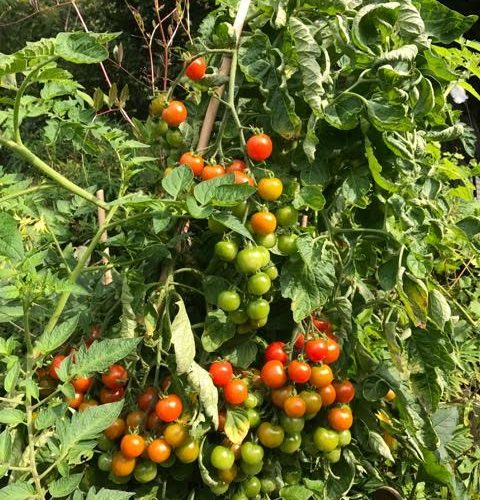
The tomato plants are now big enough to be transplanted into their grow bags. I’ve previously tried growing them in the greenhouse border and in large pots, but the most successful method is to use Growpots in conjunction with grow bags. It’s worth shopping around for them as prices vary. Lakeland’s current offer is buy one (pack of 3 – sufficient for 1 growbag) and get a second half price. The Growpots are a bit fiddly to set up, but once you have got the tomatoes in situ, they are easy to manage and will produce really good crops. And they are robust and re-useable - so it’s a once only purchase.

Seed sown in the greenhouse: Basil - thinly scattered on the surface of compost in a 10cm pot, lightly covered with vermiculite, then sealed in plastic bag to await germination, Crystal Lemon and Green Fingers outdoor cucumbers, Avalon Butternut and Honey Bear squash in 7.5cm pots of compost.
Moved to cold frame: French beans, runner beans, onions
Potted on: sunflowers
On the allotment: planted out beetroot plugs, picked asparagus and rhubarb

SociBook del.icio.us Digg Facebook Google Yahoo Buzz StumbleUpon

National Beanpole Week

19th April, 2009 - 9:24am

The 25thApril- 3rd of May is National Beanpole Week
This is your chance to support Britain’s coppiced woodlands by choosing eco-friendly, locally-grown coppiced beanpoles and peasticks instead of imported bamboo canes. You will also be helping the environment, wildlife, rural jobs as well as ancient skills and traditions. Traditionally-managed coppiced woodlands are a really important part of our countryside because they supply us with truly sustainable wood and provide an incredibly rich wildlife habitat. Numerous special events are taking place and you can find out more on Bean Poles. A directory of suppliers can also be found on Coppice Products and on Allotment Forrestry.

Visit the Pashley Manor Tulip Festival
Now in its fifteenth year, this year’s festival takes place between Friday 24th April and Monday 4th May. (Entry £8) This quintessentially English garden at Ticehurst in East Sussex is the setting for 20,000 blooms with some 90 varieties on display - from the vibrant red and hot orange coloured tulips in the herbaceous borders to the cream, white, pale golden yellow and apricot tulips in the Elizabethan Garden and the pink and white tulips along the Terrace. Pashley’s Tulip Festival is held in association with Bloms Bulbs and if you see something you like you can place an order for bulbs to be delivered and paid for in the autumn. For more details and directions go to Pashley Manor Gardens.

A Rose that may not be a Rose
Forty-two years ago, two great rose breeders began a breeding programme with a rare plant called Hulthemia Persica, with a view to producing beautiful robust roses with a crimson heart at the centre of each flower. Although Hulthemia is arguably not a rose, it is a close relative and has proved to be a tough character, withstanding heat, drought and freezing. In the intervening years several hybrids have been produced, but this year’s trio, named The Persian Mystery Roses, have got the breeders, Harkness, very excited. They are repeat flowering, with rose-like foliage and each of the large flowers has the characteristic crimson hear. Alissar, Princess of Phoenicia and Persian Mystery are both in shades of pink while The Sun and the Heart is a beautiful soft yellow with crimson bases to the petals. £12.95 bare root only from Roses.

Keeping the Cats Away
It is an unfortunate fact that cats view a carefully prepared seedbed as a large and very inviting litter tray. This can be disheartening – not to say unhygienic. After years of devising ever-more-elaborate ways of dissuading them, I have decided that one of the quickest - and most effective - methods is to use peasticks. Simply lay them across the seedbed. There will still be sufficient light for the seeds to germinate, they are easy to move aside for weeding and the cats won’t like having to pick their way amongst the branches. I generally use last year’s pea sticks, which have become too brittle to use as plant supports but are ideal for this purpose. Once the seedlings are growing well, I reposition the peasticks so that they are in parallel rows between the seedlings for a few more weeks, before removing them entirely. Then I put them through the shredder and use them as a mulch.

SociBook del.icio.us Digg Facebook Google Yahoo Buzz StumbleUpon

Of Baby Birds & Alligators

16th April, 2009 - 1:04pm

We have baby robins! At the end of the house there’s a corridor-like glazed area where I over-winter tender plants. It also has shelves where tools are stored (stick with me, this is relevant), one of which is a (normally) very useful cordless Alligator - a sort of hybrid powered lopper/chainsaw. The robins have built their nest well out of sight, right inside its box. There are just a few leaves visible, but much twittering can be heard and the Alligator is out of bounds until the babies have flown. When its not protecting robins, I really like using the Alligator - it has much of the power of a chain saw, can cut through substantial branches, but its chain is safely contained within its jaws.

I get a real buzz out of this type of interruption to everyday garden tasks. So, maybe a few things will have to be put on hold, but if my robins successfully raise their brood, it is confirmation that I am succeeding in creating a garden that is really wildlife friendly.

Over the past week we have had near perfect weather – warm sunny days and a couple of nights when it rained steadily, but gently. Of course this does mean that the slugs and snails have emerged from hibernation but I’m hoping that the application of the first batch nematodes from Green Gardner, plus a regular slug patrol and copper barrier tape will mean that they won’t have it all their way. I’m also going to give a new copper paint a try this year. Although it is expensive, it will last at least 10 years and can be applied to pots or the edges of raised beds. It is available from Copper Bed.

Seed sown in the greenhouse:
In Rootrainers : runner beans, climbing Borlotti beans and Goldfield, which is a particularly delicious flat yellow bean.
In individual pots: Gem Squash - this is a trailing squash that bears tennis ball size fruit which are delicious picked fresh, but also ripen for winter use when they develop a rich nutty flavour. Seed is available from Mammoth Onion.

Planted out in the Garden:
The sweetpeas are now in position, the first of the spring onions have been planted out and a box of baby leaves has been positioned close to the kitchen door where it can be harvested easily.

Planted out on the Allotment:
The first gutter of peas has now been planted out and covered with a mesh tunnel to keep the pigeons at bay. As soon as they have settled in and put on a bit of growth we will remove the tunnel and give them peasticks to clamber up.
Maincrop potatoes.

No Dig Gardening
The acknowledged expert exponent of this very appealing method of gardening is Charles Dowding. As well as writing Organic Gardening – the Natural No-Dig Way (available from Green Books), he runs courses (£75 per one day course) on this and related topics on his farm. They are very popular and fill up quickly, so early booking is recommended. For more details go to Charles Dowding.

Here’s a Funny Thing
I love trawling garden websites from other parts of the world, looking for emerging trends, good ideas and the downright quirky. They don’t come much quirkier than ‘The Wearable Garden Stool’. You step into a webbing harness, fasten it in place over your hips and voila - the seat is strapped to your backside with what appears to be a metal pigs tail protruding from it at 45 degrees. Apparently it was originally developed as a milking stool and is used by agricultural workers but I can’t imagine it ever being useful enough for me to risk being seen wearing it - and it weighs a substantial 4 lbs. Judge for yourself on www.cleanairgardening.com and should you succumb, please send me a photograph of you wearing it!

Looking Good in the Garden!

SociBook del.icio.us Digg Facebook Google Yahoo Buzz StumbleUpon

The Secrets of Successful Composting

7th April, 2009 - 9:25am

Learn the Secrets of Successful Composting
Garden Organic at Ryton is holding one of their Muck & Magic compost workshops(members £25/ non-members £30) between 1.30 on the 16th of April. The course will include compost, leafmould, manure, green manure, comfrey liquid and crop rotation - all materials or methods used by organic gardeners to improve and maintain soil fertility. What, when, where and how to make and use them are the questions that will be answered in this fascinating afternoon course with Garden Organic’s expert advisors.

Alternatively
If you can’t get to Ryton, can I recommend Ken Thompson’s wonderful little book Compost. Available on Amazon for £10.39. He makes the whole topic easy, entertaining and informative.

Make do & Mend
It is always sad when a favourite terracotta pot breaks, especially if it is a lovely old weathered one. It doesn’t have to be consigned to crocks though if you get yourself some Milliput www.milliput.com. This epoxy putty will make a strong permanent repair. To stop the repair looking too obvious, I rub a little bit of soil onto it to tone it down.

My Shed of Shame
Do you have something in your garden that does you no credit as a gardener? I think my top contender must be my shed. From the rotting door and broken window, to the chaos that ensues when I decide that I must have a seed tray that is at the bottom of the pile on the top shelf, it is a place that more often resembles the contents of a skip than a place of storage. Every couple of years I will steel myself and get in there, unravelling wires that have inextricably woven themselves through netting, stacking seed and pot trays separately instead of in a higgledy-piggledy jumble, uncovering lost tools and generally marvelling at the rubbish that I have accumulated. In my defence it has to be said that, even at the best of times, it isn’t a very inviting place. Tucked into the hill, underneath the garage, it is always dark and has a low entrance at just the right height to bang my head – which I invariably do at some point. This certainly doesn’t engender the warm feelings that many gardeners have for their sheds. Do you have a similar horticultural confession? It would be good to know that I’m not the only one with a horticultural slob lurking beneath an apparently orderly exterior.

“Plump-as-willow catkin, primrose-breasted,
This sky-capped morsel magnifies the Spring.”

From Blue Tits by Phoebe Hesketh

I Couldn’t do Without - my copper trowel. In a lifetime of gardening I’ve owned a vast selection of trowels, but none can compare with this lovely implement. It is light, yet strong and slices through the soil like butter. Not only is the Castor (£27 incl p&p) trowel a perfect marriage of beauty with utility, but the makers also believe that using a copper tool creates an electrostatic charge which helps repel slugs. For this and other lovely copper garden tools go to Implementations.

Garden Visits – start in earnest of the Easter weekend, but unless you are strangely fond of traffic jams and like your gardens packed with people, you are probably better off sticking close to home. One of the best ways to find a garden nearby is to consult The National Gardens Scheme Yellow Book (£8.99) or go to their website where the Garden Finder will provide you with a list of all the gardens open in aid of their charities in your vicinity.

Timely Advice
Good Friday is traditionally the day to plant maincrop potatoes.
Dead-head naturalised bulbs as the flowers die back to keep them vigorous and healthy
Order biological pest controls for your greenhouse from Green Gardener.
Tidy pond margins, cutting back dead foliage and dividing overcrowded plants, including water lilies.
Be sure to shade seedlings in the greenhouse on sunny days.

SociBook del.icio.us Digg Facebook Google Yahoo Buzz StumbleUpon

The Pleasure of Pottering

4th April, 2009 - 12:42pm

What a difference the light evenings make. From now on the garden is no longer a weekend affair, I’m out there every evening. It makes a huge difference - effectively 10 more hours a week to get things done. Instead of whizzing round like a top, I have time to enjoy the ritual of the routine tasks, plan and potter. I’m a great fan of pottering – I’ve just looked it up in the dictionary, which defines it as a particularly British pastime, meaning ‘to be busy in a pleasant but aimless way.’ I think pottering is good for the soul. An example of pottering activity this week - I have an old galvanised water tank topped with a slab of slate which can be seen from the bedroom window. To brighten it up, I collected some of the prettiest pots of spring flowers and arranged them on it and I can now admire them every time I look out of the window.

Pottering aside, sowing and planting is progressing well – so much so that the greenhouse is beginning to burst at the seams. It is a truth universally acknowledged that a greenhouse is NEVER big enough. I am limited by the steeply sloping site and it actually took 10 years to work out where in the garden I could possibly find a suitable space, so my small, but perfectly formed greenhouse is currently as tightly packed as a rush hour train. I think the time has come to pull up the salads that we have harvested through the winter (mizuna, red mustard, landcress, lamb’s lettuce, rocket) and use the border for the trays of seedlings, until they can move to the coldframe or go outside.

Seed sown in the greenhouse:
In Rootrainers :sweetcorn, parsnips ( a bit of an experiment, they are so slow/reluctant to germinate in open ground) and more spinach.
In small pots: dwarf French beans to provide an early crop while we wait for the climbing beans.
The heated propagator:
Is having a bit of a rest this week – I plan to do some more sowing over Easter. Delaying may mean that crops are a bit later, but it does avoid even more congestion in the greenhouse.
The Allotment:
Andrew planted the 2nd early potatoes and prepared the ground for the first gutter of peas to get planted next weekend. He also brought home delicious purple sprouting (it had looked very unpromising a month ago) and an armful of rhubarb.

Hurry, Hurry
If you are quick there’s still time to grab yourself a bargain from Suttons. They are coming to the end of their fruit tree despatches and have a lucky dip selection of the remaining trees (£7.99 per tree), chosen by their experts for taste and productivity. It’s the perfect opportunity to start a mini-orchard and save 50% off the catalogue price. Check their website for full details of this and other money-saving offers.

Fragrant Delights
If you didn’t get round to sowing your sweet peas in the autumn, you can buy a collection of sweetly-scented old-fashioned varieties (£10.76 for 10) from Crocus. The varieties have been specially selected for them by their favourite sweet-pea specialist and plants have been pinched out to ensure they are bushy, with well-developed root systems.

Looking Good in the Garden

Chaenomoles 'nivalis'

Chaenomoles 'nivalis' - These are shaping up to be a good hedge against the north facing fence. Regular pruning of sideshoots encourages it to thicken out and flower well.

Primula Gold Lace

Primula Gold Lace - An old-fashioned favourite that flowers reliably each spring. After flowering I will divide it, repot and leave it in a cool spot for the summer.

Lily of the Valley - I love the appearance of the young shoots as they erupt from the ground with their promise of delicious fragrance in the weeks to come.

Lily of the Valley - I love the appearance of the young shoots as they erupt from the ground with their promise of delicious fragrance.

Brunnera macrophyllaPG - At its loveliest at this time of year - needs cutting back after flowering when its charms are less obvious.

Brunnera macrophyllaPG - At its loveliest at this time of year - needs cutting back after flowering when its charms are less obvious.

Helleborus orientalis - Hellebores love  growing on the shady bank next to the path that leads down to the greenhouse.

Helleborus orientalis - Hellebores love growing on the shady bank next to the path that leads down to the greenhouse.

Tulipa turkestanica - With its lax habit, this tulip either needs twiggy support, or to be viewed at table top level.

Tulipa turkestanica - With its lax habit, this tulip either needs twiggy support, or to be viewed at table top level.

Tulipa turkestanica - This delicate species tulip has a prime position on my table top display.

Tulipa turkestanica - This delicate species tulip has a prime position on my table top display.

Tulip Fur Elise

Tulip Fur Elise- This beautiful species of tulip has a prime position with my garden.

SociBook del.icio.us Digg Facebook Google Yahoo Buzz StumbleUpon